
May
Research Node for Aesthetic Studies: special seminar with the Faculty of Humanities 2026 Honorary Doctors
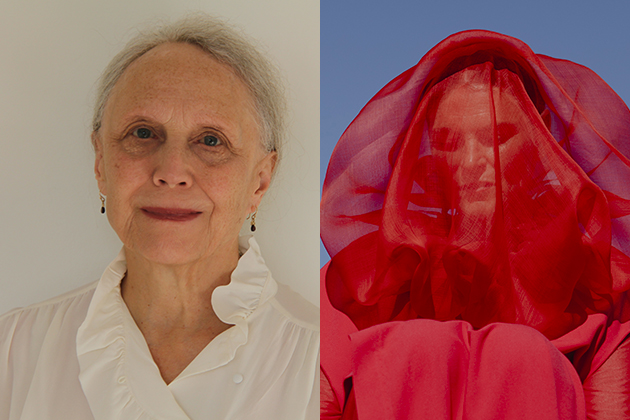
Welcome to a seminar with the 2026 Honorary Doctors of the Faculty of Humanities, hosted by the Research Node for Aesthetic Studies. This special seminar brings together Professor Georgina Born and artist Gry Worre Hallberg, who will present their current work.
Please note the change of venue! The seminar will be held in LUX:B352.
You can read the Faculty’s announcement about the new honorary doctors (in Swedish) here.
After the seminar, you are warmly invited to stay for an informal reception where food and drinks will be served for those who have registered in advance. Please see the registration details below.
Georgina Born
Time and Musical Genre
Georgina Born is Professor of Anthropology and Music in the Department of Anthropology, University College London.
Abstract:
Drawing on theoretical precursors from philosophy and art history, in this paper I address the challenge of conceptualizing the relationship between musical genre and time. Genre, I will suggest, exemplifies the two-way mediation of music and time: genres produce time through the contingent articulation of their multiple temporalities; in turn, historical processes – the temporalities associated with changing cultural, social, technological and mediatic conditions – influence the development of genres. Genres therefore make time (Born 2015) in the sense of activating specific types of temporal experience; moreover, they may also engender social and cultural change. I highlight several key forms of generic temporality: iteration and citation, retention and protention. In particular, Husserl’s (1964) couplet of retention and protention, as they have been reinterpreted by cultural anthropologists (Munn 1992, Gell 1998), a reinterpretation that I now extend to genre, makes it possible to supersede the linear, “developmental form of chronology” (Karlholm and Moxey 2018) on which histories of art and music have often been based. In parallel, they proffer alternatives to the essentialisms on which the paradigm of historical “influence” is built. In these ways, musical genre illuminates the nature of cultural time, including its folded, nonlinear and recursive qualities. The times of genre, it is proposed, must be thought together in terms of the intercalation of these different temporalities (Galison 1988), with their distinct rhythms, rates, and scales of change.
Her talk is based on her chapter in the forthcoming Music and Genre that she edits with David Brackett. The chapter will be sent in advance by contacting sanne_krogh.groth@kultur.lu.se
Gry Worre Hallberg
Sisters Hope Archive, in situ material, and interventionist practice
Gry Worre Hallberg is an artist and founder of the performance group Sisters Hope in Copenhagen.
Abstract:
An introduction to Sisters Hope’s performance practice and archive, focusing on the generation of in situ material and on interventionist aspects that move beyond the art institutional context with a foundational intention to 'democratize the aesthetic'.
Recommended reading for the seminar are the following sections from Hallberg’s artistic PhD dissertation Sensuous Society:
- Generation of reflective material in situ p. 39–43 [in resonance with aspects on the presentation on in situ data]
- Interatcivity, immersion and intervention + Sensuous Society >< Aestheticization p. 65–81 [in resonance with the aspects on the presentation on intervention]
- Return to case A: Mental ecology: The Poetic Self Blue and Calm p. 316–338 [as an example of analyzing in situ material]
The dissertation is accessible here.
To attend this seminar, please register via email to valeria.naters@kultur.lu.se.